
Ara macao | Scarlet Macaw
Name: Goose (Female)
Meet Goose the Scarlet Macaw
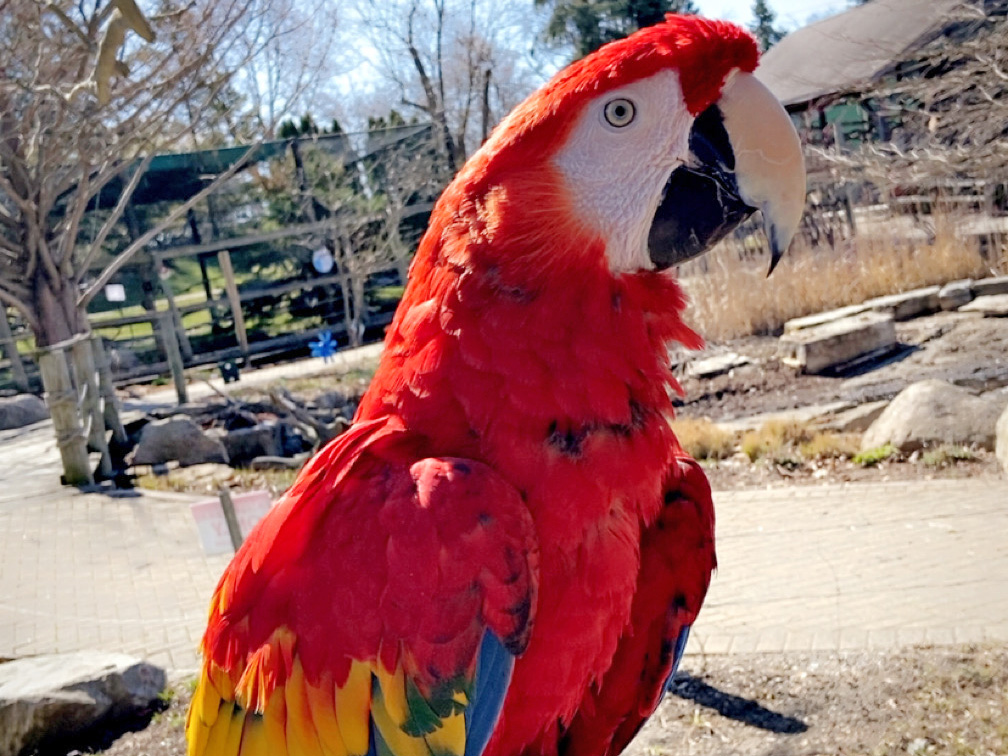
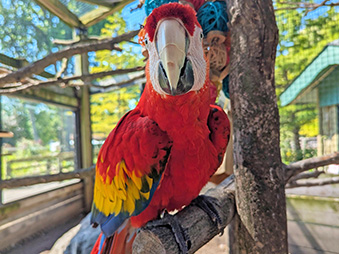
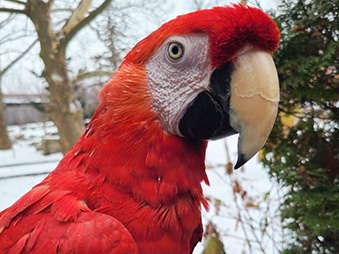
Scarlet macaws, like Goose, are remarkable birds—intelligent, social, deeply loyal, and among the most brilliantly colored species on Earth. With fiery red, bright yellow, and striking blue plumage, they are often called “the rainbows of the rainforest.” Their pale, nearly featherless facial patches and large, hooked beaks make them instantly recognizable.
Impressive Anatomy & Adaptations
Scarlet macaws possess a number of specialized traits that help them thrive in their rainforest homes.
Powerhouse Beaks:
As members of the parrot family, macaws have highly flexible, incredibly strong beaks. This gives them a bite force capable of crushing tough nuts, breaking stubborn seeds, and tearing into fruit long before it ripens. Their specialized palate and muscular tongue help grind seeds that other animals cannot eat—giving them access to food sources with very little competition.
Not Ripe? No Problem:
Because of their strength and unique diet, scarlet macaws often consume fruit that is still too hard or chemically harsh for other species. They can break through thick skins, and by eating clay, they neutralize tannins and toxins commonly found in unripe fruit.
Nature’s Seed Dispersers:
By feeding on a variety of seeds and fruits, macaws play a critical ecological role. They transport seeds across the forest, allowing trees to spread far from the parent plant. Without animals like scarlet macaws, many tree species would face lower seed survival and increased competition beneath the canopy.
Behavior & Family Life
Scarlet macaws are monogamous, which means that they partner for life. Here’s a few more fun facts about what it’s like to grow up as a macaw.
- Young macaws rely on their parents for 1–2 years.
- They reach sexual maturity at 3–4 years of age.
- Macaws sleep in flocks but typically fly and forage in monogamous pairs.
- Individuals are rarely seen alone unless one partner is incubating eggs.
- They nest in high, hollow canopy trees, using thick foliage for camouflage.
Not a Pet
Scarlet macaws like Goose are magnificent—but they are not suitable as pets. They:
- Can live up to 75 years, requiring lifelong commitment.
- Need large, complex environments to fly, climb, and socialize.
- Require specialized diets, enrichment, and veterinary care.
- Are extremely loud and highly destructive when their needs aren’t met.
Because of their beauty and value, wild macaws are often illegally taken from their nests—a process that frequently involves cutting down entire trees. This not only harms chicks and reduces wild populations but also destroys nesting habitat critical for future generations.
One of the best ways to help protect macaws is to support accredited zoos, legitimate conservation organizations, and to never purchase a wild-caught macaw.
If you want to learn more, visit the Not-a-Pet campaign for additional resources.
Fact Sheet
Taxonomy
Species: Macao
Kingdom: Animalia | Phylum: Chordata | Class: Aves | Order: Psittaciformes | Family: Psittacidae | Genus: Ara | Species: macao |
Favorite Enrichment Type
Cardboard and paper items to shred!
Size
- 32 to 36 inches tall
Life Span
- In the Wild: 40 to 50 years
- In Human Care: 30 to 75 years
Diet
- In the Wild: Mostly consume fruit and nuts but can also be seen enjoying nectar and flowers.
- At the Zoo: Mazuri® Parrot Maintenance, parrot mash, fresh produce, mixed nuts, and oyster shell.
Geographic Range
Southern Mexico, Central, and South America, most commonly found throughout the Amazon basin.
Habitat
Found in the canopy of the forests of their geographical range, such as the deciduous forest, riverine forest, gallery woodland, humid well-drained forests of the Amazon, savanna, mangrove forests, and clearings with big trees.
Fun Facts
-
- Featherless facial patch: A unique macaw trait used for identification.
- Beak strength: Strong enough to crush nuts and climb trees.
- “Footedness”: Many individuals are left-footed, using that foot to hold food and toys.
- Highly vocal: Skilled mimics with an impressive range of calls.
- Excellent senses: Sharp vision and hearing help them detect predators and communicate across long distances.
- Vocal and expressive: Known for their talking (imitation) ability and wide range of calls.
Status: Least Concern
Conservation in Action
Although the species as a whole is listed as Least Concern, their population is on the decline.
Major threats include:
- Deforestation and habitat loss.
- Illegal capture for the pet and feather trade.
- Natural predation by raptors, snakes, monkeys, and jaguars.
Conservationists are working to protect nest trees, monitor wild populations, restore forests, and reintroduce macaws through carefully managed breeding programs. Ecotourism, local engagement, and community education all play essential roles in long-term recovery.
What You Can Do
- Never support the illegal exotic pet trade.
- Donate to macaw and rainforest conservation programs.
- Support ecotourism and reforestation efforts.
- Share the importance of macaws as seed dispersers and indicators of healthy forests.
How to Find Me
Come hang out with Goose in the large habitat next to the Awareness Amphitheater and across from the Wobbly Bridge!