
Capra aegagrus hircus | San Clemente Island (SCI) Goat
Names:
- Male: Troy
- Female: Verona, Ithaca, Seneca, Elmira, Savannah

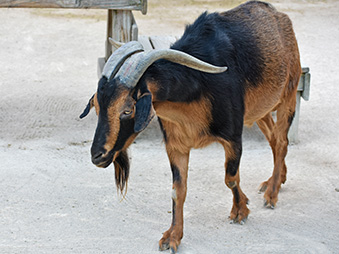
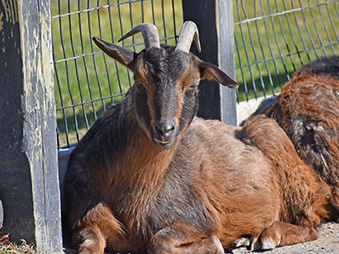
Meet the San Clemente Island Goats
Say hello to our lively herd of San Clemente Island Goats—Troy, Verona, Ithaca, Seneca, Elmira, and Savannah. With their deer-like build, curious nature, and endless enthusiasm for climbing, these goats are as entertaining as they are important. As a rare heritage breed with a mysterious past and remarkable resilience, they’re more than just barnyard favorites—they’re living pieces of agricultural history.
A Mysterious Island Beginning
San Clemente Island Goats descend from a feral population that once roamed San Clemente Island, the southernmost of California’s Channel Islands. Although their exact origin remains a bit of a mystery, historical evidence suggests they were introduced around 1875 by Salvador Ramirez, who reportedly brought them from nearby Santa Catalina Island.
For years, many believed these goats were related to Spanish breeds because of their similar horn shape. But in 2007, a genetic study by The Livestock Conservancy and the University of Córdoba revealed something unexpected: San Clemente Island Goats are genetically distinct from every known goat breed.
From Feral Herd to Conservation Success
By the 1970s, the island’s goat population had exploded to nearly 15,000, putting pressure on native plants and wildlife. Under the U.S. Navy’s management, a removal program began. Thanks to the efforts of animal welfare groups, thousands of goats were safely captured, rehomed, and returned to domestication.
Today, the breed survives because of dedicated conservation breeders. As of the most recent counts, there are roughly 1,700 goats living across 27 U.S. states and several Canadian provinces.
What They Look Like
San Clemente Island Goats are known for their:
- Fine-boned, agile, deer-like build
- Tan, brown, or black coats with varying patterns (occasionally cream or off-white).
- Both males and females having horns, with males’ horns typically twisting outward.
- Medium-length ears that may stand upright or show a slight crimp.
- Dished or straight facial profile.
These goats are also known for their gentle temperament and excellent maternal instincts. Interestingly, bucks lack the gland that produces the strong musky odor found in many other goat breeds.
Fact Sheet
Taxonomy
Genus: Capra | Species: aegagrus | Sub species: hircus |
Kingdom: Animalia | Phylum: Chordata | Class: Mammalia | Order: Artiodactyla | Family: Bovidae |
Favorite Enrichment Type
Jolly balls and bamboo!
Life Span
- In Human Care: 15 to 18 years
Diet
- At the Zoo: Orchard grass or timothy hay and pellets, mineral/salt supplements.
Geographic Range
San Clemente Island, CA.
Habitat
Mountainous areas, rocky cliffs, and alpine meadows.
Fun Facts
- Despite earlier assumptions, San Clemente Island Goats have no known relation to Spanish goat breeds.
- Some goats have extra teats, which are acceptable in the breed standard.
- Bucks typically lack the musky scent common in other breeds.
- They are exceptional climbers and love surveying their surroundings from high places.
- The island they are named for was named in 1602 after Saint Clement, though early explorers may never have actually set foot on it.
Status: Critically Endangered
A Critically Important Heritage Breed
San Clemente Island Goats are listed as “Critical” on the Livestock Conservancy’s Conservation Priority List. As a heritage breed, they carry genetics developed long before industrial-scale agriculture—including traits for:
- Fertility
- Natural foraging ability
- Disease and parasite resistance
- Longevity
- Strong maternal instincts
- Adaptability to local environments
These traits make them valuable for sustainable agriculture, especially for small farms. They are used today for:
- Rich, high-fat milk (excellent for cheese and yogurt)
- Brush clearing and land management
- Minor cashmere fiber production
- Meat (historically)
Their genetic uniqueness makes every individual important to the survival of the breed.
What Is a Heritage Breed?
A heritage breed is a traditional livestock breed that existed before the rise of industrial agriculture. These breeds were carefully selected over generations to thrive in local environments—valued for traits like:
- Self-sufficiency
- Natural fertility
- Ability to mate naturally
- Strong foraging instincts
- Longevity
- Disease resistance
- Excellent maternal care
Industrial agriculture prioritized rapid growth and high production, causing many heritage breeds to decline. Today, defining and labeling “heritage breeds” creates awareness and helps consumers—and organizations like our zoo—support their survival.
The USDA does not formally certify the term “heritage,” but farmers are allowed to label their products as such, making consumer support a powerful conservation tool.
Choosing to support local farmers who raise heritage breeds helps preserve genetic diversity and promote healthier, more sustainable agricultural practices.
A Living Link to the Past
From their mysterious beginnings to their role in modern conservation, San Clemente Island Goats embody the importance of preserving agricultural heritage. Whether they’re scaling rocks, sunning themselves, or greeting visitors with gentle curiosity, Troy, Verona, Ithaca, Seneca, Elmira, and Savannah are helping ensure this rare breed thrives for generations to come.
How to Find Us
Next to the Contact Yard.