
Python regius | Ball python, Royal python
Names: Wiffle & Disco (males)
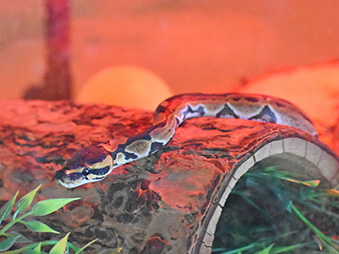
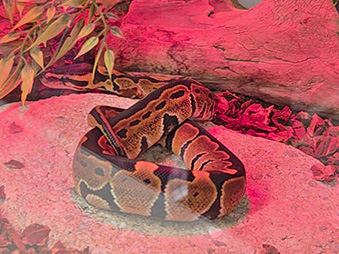
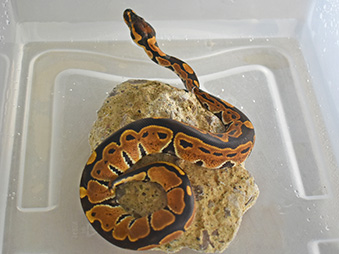
Meet the Ball Python
The Gentle Coil of the Grasslands
Meet Whiffle and Disco, our resident ball pythons! These calm, shy snakes get their name from their signature defense strategy—curling tightly into a perfect little ball with their heads safely tucked in the center. They’re also known as royal pythons, a name inspired by stories of African rulers wearing them as living jewelry thanks to their bold, beautiful patterns.
In the wild, ball pythons spend their days hidden away in abandoned mammal burrows or termite mounds, emerging at night to roam the grasslands, savannas, and lightly wooded areas of western and central Africa. Though they’re capable climbers, they prefer life on the ground where the shade and moisture of underground retreats help them escape predators, scorching heat, and dry air.
Masterful Nighttime Hunters
Nighttime brings out the ball python’s inner predator. As ambush hunters, they choose a perfect hiding spot, then wait patiently for prey to stroll by. Their brown-and-black patterns help them melt into leaf litter until—snap!—they strike.
Ball pythons navigate the darkness with two incredible tools:
- Jacobson’s organ: Reads chemical cues collected on the forked tongue. Because the tongue splits, it helps the snake “smell in stereo” and pinpoint which direction the scent is stronger.
- Labial pits: Tiny heat-sensing organs around the mouth that allow the snake to detect the body heat of prey.
Once a python lands a hold, it doesn’t use venom. Instead, it relies on constriction—wrapping its coils around its prey and tightening just enough to stop the animal from breathing. Its backward-pointing teeth help guide the meal down the hatch, and stretchy ligaments in the jaw allow the snake to swallow animals far wider than its head. Even while eating, a python can breathe using the glottis, a tubular structure that extends like a snorkel.
Growing Up Python
Ball pythons are oviparous, meaning they lay eggs. Females deposit 3–11 eggs and coil around them protectively for around 90 days, keeping them warm and safe—an unusual level of maternal care among snakes.
Young pythons grow slowly, reaching maturity at:
- Males: 12 to 18 months
- Females: 24 to 36 months
In the wild, ball pythons live around 10 years, but in human care they can reach 20–40+ years, placing them among the longest-lived snake species.
These are one of the smallest African python species, reaching 3–5 feet (rarely up to 6 feet). Adult females are larger with longer jaws, a clear example of sexual dimorphism. Eggs are laid during the dry season—February to early April—and hatch from mid-April to mid-June. Hatchlings are fully independent from day one but often linger near the nest before exploring the world on their own. Pythons can continue reproducing for decades, from around 27 months old all the way into their 30s.
Important to Nature and to People
Ball pythons play essential roles in African ecosystems. As rodent predators, they help control agricultural pests and are valued by many communities, some of which consider them sacred and protect them through cultural traditions. By keeping rodent populations in check, they also help limit the spread of disease and maintain balance in the food web.
At the same time, pythons are prey for larger mammals, birds of prey, and even other snakes—making them a vital link in their environments.
Fact Sheet
Taxonomy
Genus: Python | Species: regius |
Kingdom: Animalia | Phylum: Chordata | Class: Reptilia | Order: Squamata | Family: Boidae |
Favorite Enrichment Type
Balls, holey-roller ball, antlers/branches to climb, fake plants, anything to climb or that has fun texture, and their pools to soak in.
Life Span
- In the Wild: 10 years
- In Human Care: 20 to 40+ years
Diet
- In the Wild: Small mammals like rats and shrews, birds, and the occasional amphibian
- At the Zoo: Mice and rats
Geographic Range
Western and Central Africa
Habitat
Ball pythons inhabit grasslands and open forests. They prefer areas that provide some cover, usually where water is available to cool themselves when the weather is hot.
Fun Facts
- They curl up like a cinnamon roll when scared, hence the name “ball” python.
- Their other name, royal python, comes from legends of African royalty wearing them as jewelry.
- They “smell” with their tongue, collecting chemical signals and delivering them to a special organ in the roof of their mouth.
- They can “see” heat using labial pits, letting them hunt warm-blooded prey in total darkness.
- Their jaws don’t detach, they stretch like rubber bands to swallow big meals.
- They are ambush predators, patiently waiting for prey rather than chasing it.
- Mom stays with the eggs! Ball pythons are unusually attentive parents among reptiles.
- Despite being a python, they’re actually one of the smallest of the species—usually just 3–5 feet long.
- With proper care, these snakes can live 40+ years, making them one of the longest-lived pet reptile species.
- In their native habitats, they help farmers by eating rodents and are considered sacred in some communities.
Status: Near Threatened
Ball python populations are declining due to:
- Over-collection for the pet trade.
- Hunting for food
- Habitat loss from expanding agriculture and development
Every year, 30,000–50,000 ball pythons enter the wildlife trade, many of them hatchlings taken from the wild. Although captive breeding is increasing, unsustainable collection still poses a serious threat.
Protecting natural habitat, supporting ethical breeding programs, and reducing demand for wild-caught animals are key to ensuring the species’ future.
Not a Pet
Although often marketed as “easy” pets, ball pythons require:
- Precise temperature and humidity control
- Specialized habitat setups
- A commitment of 30+ years
- Knowledge of reptile behavior and nutrition
Many snakes in the wildlife trade experience extreme stress, injury, or death during capture and transport. Even in private homes, surrendered snakes are common when owners discover how complex long-term care can be.
If you love ball pythons, the best way to support them is by visiting accredited zoos, supporting rescues, and engaging with conservation programs—not by purchasing wild-caught individuals.
Want to learn more about choosing appropriate pets? Check out the Not a Pet Campaign!
How to Find Us
Come meet our two ball pythons, Wiffle and Disco in the new Wild in Nature building, between the Barnyard and Train Whistle Cafe.