
Michigan Bat Monitoring Program
Bats play a large role in controlling populations of insects, such as mosquitos, and are important pollinators in many parts of the globe. Unfortunately, a disease called white-nose syndrome has been decimating several species of bats. The Michigan Bat Monitoring Program was established to collect information on the nine bat species native to Michigan using acoustic monitoring. The Detroit Zoo provides training and guidance for volunteers working in this program.
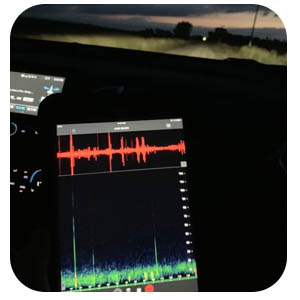
The Saginaw Children's Zoo is a participant, and helps collect data on bat species and habitat use in our area. At night during the summer months, staff and volunteers drive out to the Shiawassee Nature Preserve with a hypersensitive microphone secured to the top of a vehicle. They drive slowly through the preserve while the microphone picks up bat calls in the area. The data is sent to a tablet, which attempts to identify the species of bat based on its call. Once several trips have been completed, the equipment and data are sent back to the Detroit Zoo where biologists analyze the data. This helps them determine which species, and how many are in the area, as well as the types of habitats these animals are utilizing.
To learn more about the bats in Michigan, click here. Only staff and Core Adult Volunteers are able to participate in the survey trips by the Saginaw Children's Zoo. To learn more about becoming a Core volunteer, click here.

Sandhill Crane Migration Survey
Each Fall, Zoo staff participate in the US Fish and Wildlife Sandhill Crane Survey. With binoculars in hand, a small team drives through the Shiawassee National Wildlife Refuge to count and record all the Greater Sandhill Cranes observed. Greater Sandhill Cranes (Grus canadensis) have been surveyed annually in this region since 1979.
The main goal of this survey is to monitor how many Greater Sandhill Cranes utilize the Shiawassee National Wildlife Refuge as part of their migrations. In 2020 our staff recorded close to 3,000 cranes!
To learn more about this study click here.